Humane Wildlife Removal vs. Lethal Control: How to Decide What Works Best
October 24, 2026
Quick answer: If you find a snake on your property, stay still, back away slowly, and keep people and pets away from the area. Don’t try to kill, trap, or move the snake yourself. Most snake bites happen when someone tries to handle a snake that would’ve left on its own. Note where it was and what it looked like, then call a wildlife professional if it’s near your home, in a garage, or you can’t confidently identify it as harmless. Most snakes people find in their yard are non-venomous and gone within the hour if left alone.
You’re pulling weeds. Or grabbing the mail. Or your dog is barking at something in the flower bed for no reason you can see yet. Then you see it. A snake, coiled or stretched across the walkway, close enough that your heart rate just doubled.
Calm down! you’re probably fine. Here’s what to actually do next.
First, don’t do any of these things
Bites happen during the “let me just move it” moment, not while it’s minding its own business.
- Don’t grab it, pin it, or try to trap it in a bucket
- Don’t throw anything at it or try to kill it with a shovel or hose
- Don’t corner it against a wall or fence. A scared snake with no exit becomes a defensive snake
- Don’t assume you’re safe just because it’s “just a garden snake”. Size and color are unreliable ways to judge a species from a distance
A snake that feels cornered strikes to defend itself. A snake with an open path almost always chooses to leave.
Step back, then actually stop and look
Once you’ve put a few feet between you and the snake, and pets or kids are called inside, take thirty seconds to actually observe it.
Look at:
- Head shape. Venomous pit vipers in South Carolina, like copperheads, generally have a broad, triangular head that’s noticeably wider than the neck. Harmless species usually have a narrower, more rounded head.
- Body pattern. Copperheads have hourglass-shaped bands. Rat snakes and king snakes have more uniform or blotchy patterns that don’t pinch in the middle.
- Behavior. Is it trying to leave, or holding its ground? Most non-venomous species retreat the moment they’re spotted. A snake that stays coiled and watching is worth extra caution, not necessarily because it’s venomous, but because it feels threatened.
- Location. A snake sunning itself on a warm driveway in April behaves differently than one that’s actually made a home in your crawlspace.
If any part of this feels uncertain, treat it as venomous until proven otherwise. That’s not just the safer default.
Take a photo, from a distance, if you can do it safely
A photo from six feet away, taken with a phone’s zoom rather than by stepping closer, is genuinely useful. It lets a professional identify the species without guesswork, which changes how urgently you need a response and what happens next.
Never approach closer to get a better shot. An identifiable photo from a safe distance beats a perfect photo from a dangerous one, every time.
When it’s fine to just let it be
Most snake encounters end with nothing happening at all. If the snake is:
- Out in the open yard, not near a door or foundation
- Actively moving away from you
- Something you can identify or reasonably suspect is non-venomous
…the simplest move is often to just leave it alone and let it go about its business. Snakes eat rodents, which makes them a quiet form of pest control most homeowners never think to thank. A snake passing through your yard today is frequently a sign that something else, usually mice, drew it there in the first place. So, you might also need an inspection for rodent removal too.
When it’s time to actually call someone
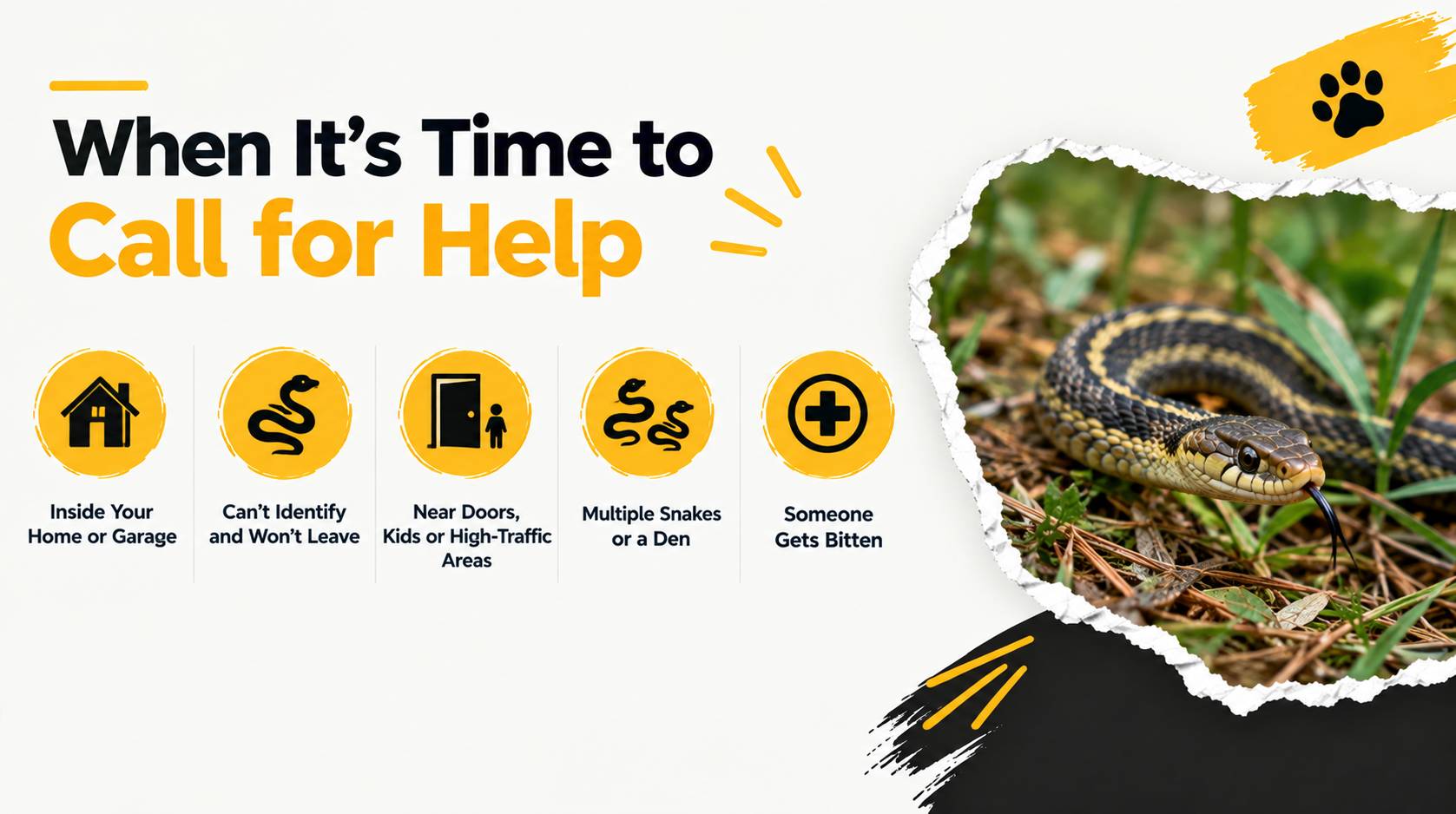
Some situations shift from “watch and wait” to “pick up the phone.” Call a professional for snake removal if:
- It’s inside your house, garage, or attached structure. Indoor sightings need a professional response, both because removal from inside a home is trickier than an open yard and because it usually means there’s an entry point worth finding.
- You can’t identify it, and it’s not leaving. Uncertainty plus a snake that’s sticking around is the exact combination that calls for someone with actual field experience.
- It’s near a door, a kid’s play area, or somewhere people walk daily. Even a harmless species in a high-traffic spot is worth having professionally relocated, just to remove the daily close-call risk.
- You’ve seen multiple snakes, or evidence of a den. One snake is a visitor. Several is often a sign of a rodent problem feeding a small colony, and that’s worth addressing at the source.
- Someone gets bitten. This is the one non-negotiable. Call 911 or get to an emergency room immediately. Don’t wait to identify the species first, and don’t attempt any home remedies like ice, suction, or a tourniquet, all of which can make things worse.
The species you’re most likely to actually encounter
Around Columbia, Lexington, and the rest of the Midlands, the snake showing up on your patio is statistically more likely to be helpful than dangerous. Copperheads are the venomous species homeowners run into most often here, and they’re frequently mistaken for several harmless lookalikes. This guide to identifying venomous species in the Columbia Midlands breaks down species by species with photos and pattern comparisons.
Why snakes show up in the first place
A single snake sighting isn’t usually random. Snakes go where food and shelter are, which means a yard with tall grass, woodpiles, debris, or a rodent problem is far more attractive to them than a tidy one.
If you’re seeing snakes regularly, or a snake shows up right after you noticed scratching in the attic or droppings near the foundation, those two things are probably connected. Clearing out a rodent population removes the reason the snake came looking in the first place, and it’s worth having that checked alongside the snake sighting rather than treating them as separate problems.
Snake removal is not a DIY project, even for the confident
We get it. YouTube makes it look simple: grab the tail, drop it in a bucket, drive it somewhere else. In practice, misidentification is the single biggest risk here, and it’s one that costs people an emergency room visit every year in South Carolina.
Professional removal means the snake gets identified correctly, handled without unnecessary stress to the animal, and relocated in a way that follows state wildlife guidelines, since not every species can legally be moved off-property. It’s the same hands-on approach we use for wildlife removal across the Columbia area, just adapted to a species that moves fast and doesn’t appreciate being chased.
What to expect when you call us
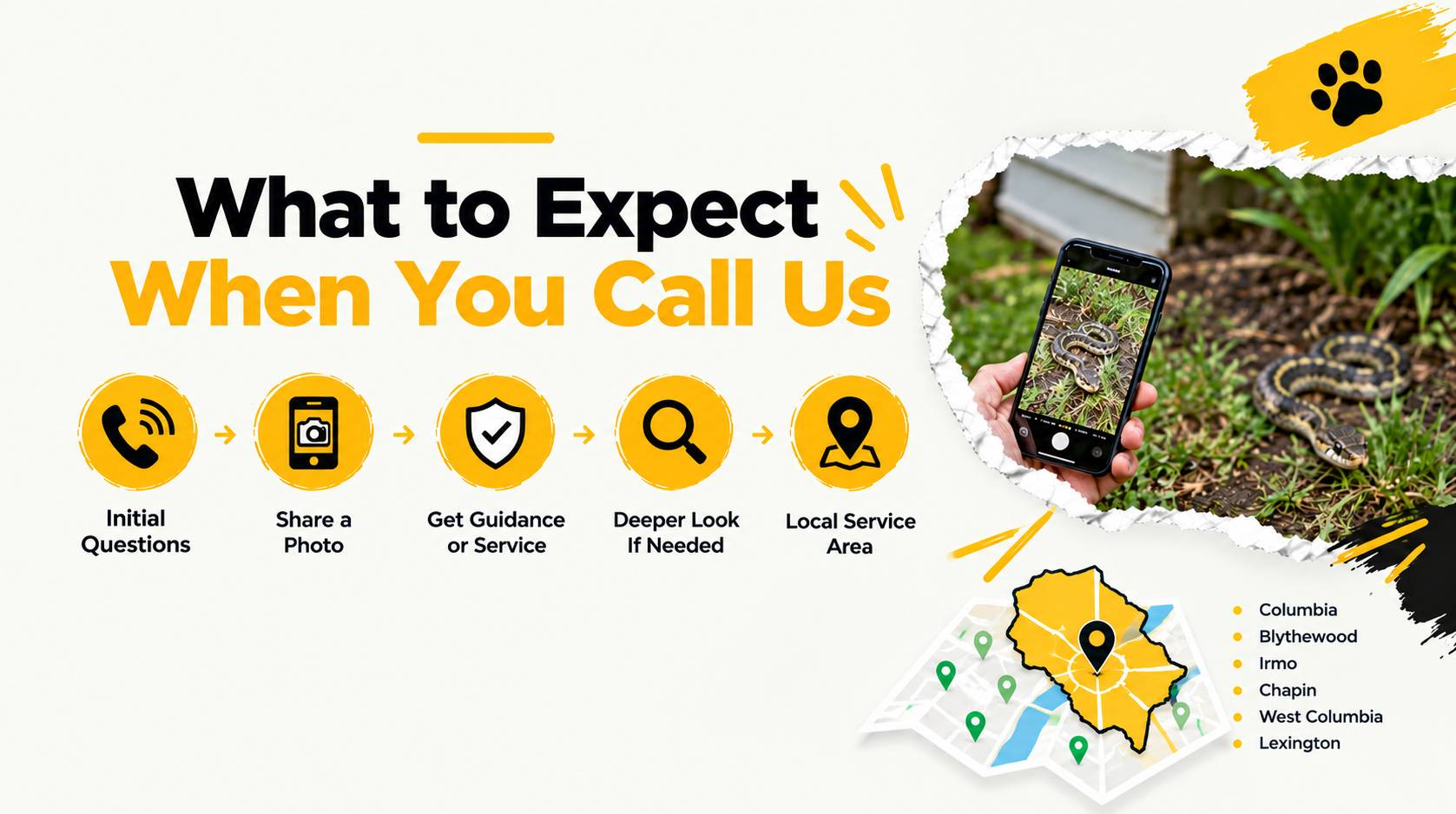
When you call about a snake, we’ll ask what it looked like, where you saw it, and whether it’s still visible. If you have a photo, send it. It speeds up everything. From there, we’ll either walk you through confirming it’s safe to leave alone, or send someone out to identify and remove it directly.
If the snake turned out to be a symptom of a bigger rodent issue, or you’re finding gaps around your foundation or crawlspace that could be letting things in, that’s worth a broader look too.
We serve Columbia, Blythewood, Irmo, Chapin, West Columbia, and Lexington homeowners.
Our Final Advice
Don’t touch it. Back away. Look, don’t approach. Photo from a distance if you can. Leave it alone if it’s clearly passing through and harmless. Call a professional if it’s indoors, unidentified, or somewhere people walk daily. Call 911 immediately if anyone’s bitten.
Most snake stories end with the snake leaving on its own and nobody getting hurt. Following these steps is what keeps yours one of those stories.
Blythewood Wildlife Removal
Phone: 1-803-760-9166
Email: [email protected]
Hours: Open 24 hours
Address: 1314 Lincoln St, Columbia, SC 29201
Serving: Columbia, Lexington, Blythewood, Irmo, Chapin, and West Columbia
- What Should I Do If I Find a Snake on My Property? Tips For South Carolina Folks - October 25, 2026
- Humane Wildlife Removal vs. Lethal Control: How to Decide What Works Best - October 24, 2026
- The Hidden Entry Points Wildlife Companies Miss: A Home Inspection Checklist for Rooflines, Soffits, and Utility Gaps - October 23, 2026