Signs of a Raccoon in the House and What to Do About It
September 16, 2026
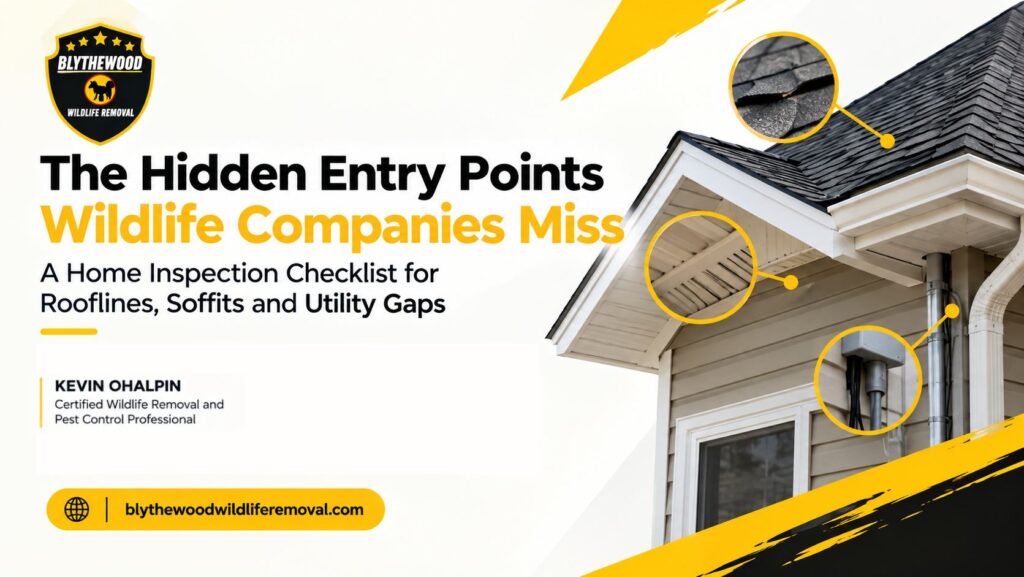
The Hidden Entry Points Wildlife Companies Miss: A Home Inspection Checklist for Rooflines, Soffits, and Utility Gaps
October 23, 2026
Quick answer: Local wildlife removal companies typically respond faster and send the same person who quoted the job, so accountability is direct if something goes wrong. National chains offer standardized pricing and brand consistency, which suits multi-state property managers more than single homeowners. Check response time, who owns the outcome if the animal returns, and whether the guarantee covers sealing and repair, not just removal, before choosing either.
If you have an animal in your attic, walls, or crawlspace, the company you hire decides how fast it gets solved and who answers for the result. A local wildlife removal company usually responds faster, sends the same person who quoted the job, and stands behind the work in a way you can check. A national chain offers a familiar name and standard processes, which suits some homeowners well. The right pick depends on how much the speed and accountability matter to your situation.
I run a local company in the Midlands, so I have a view here. I’ll still be fair to the chains, because there are situations where one makes sense.
How local companies and national chains are set up differently
Most national wildlife and pest brands work through a central office plus regional branches or franchise owners. You call a toll-free number, an intake team logs the request, and the job is passed to whoever covers your zip code. That structure works well for booking volume and keeping pricing consistent across many states.
A local company is built around the people doing the work. When you call us, the person picking up is often the person who will climb into your attic that day. I’ve spent over 15 years running this business, and that history is tied to one region, one climate, and one type of housing stock. There’s no handoff between the person who hears your problem and the person who fixes it.
Neither model is wrong. They just produce different experiences when something is scratching above your bedroom at 2 a.m.
| Local company | National chain | |
| First contact | Usually the technician or owner | Call center or online form |
| Dispatch | Direct scheduling, often same day | Routed through a regional branch |
| Pricing | Quoted for your specific property | Often based on standardized packages |
| Follow-up | Same person returns | Depends on branch staffing |
| Local knowledge | Deep, built over years in one area | Varies by branch |
Why response time matters more with wildlife
Wildlife problems get worse by the hour in ways that other home repairs don’t. A raccoon tearing at insulation keeps tearing. A squirrel nesting near wiring is a chewing risk that grows every night. And if an animal has died inside a wall, South Carolina heat and humidity speed up decomposition, which makes the smell and contamination harder to deal with each day you wait. I explain how that process works and how to trace the source in my guide to dead animal removal and odor control.
This is where a local schedule helps. When there’s no routing step between your call and the technician, same-day visits are far more realistic. We’re open around the clock because animals don’t keep office hours. A chain can also offer fast service, but it depends on whether your local branch has someone free, and that isn’t something you can know in advance.
A useful test is to call two or three companies and see what happens. Note how long it takes to reach a real person, whether they ask specific questions about what you’re hearing or seeing, and whether they can give you a visit time or only a callback window.
What accountability looks like in practice
Accountability is easy to promise and harder to verify, so it helps to look for concrete signs.
The first is who owns the outcome. If the animal comes back in three weeks, you want to reach the person who did the work, not open a new ticket with a general line. With a local operation, that person has your address, remembers the entry points they sealed, and has a direct reason to come back and fix it, since their reputation in your neighborhood is on the line.
The second is the reviews. A local company’s reviews come from neighbors, often in the same towns, and you can usually see the pattern over years. We’ve completed more than 2,550 jobs and hold over 200 five-star Google reviews, and anyone can read them, including the critical details customers mention about timing and cleanup. When you compare companies for wildlife removal in Columbia, SC, read reviews for the specifics. Reviews that describe what the technician found and how the follow-up went tell you more than star totals.
The third is the written guarantee. Ask exactly what it covers, how long it lasts, and what you need to do to keep it valid. A guarantee that only covers the trapping but not the sealed entry points isn’t protecting you from the thing you care about, which is the animal not returning.
Local knowledge changes how the job gets done
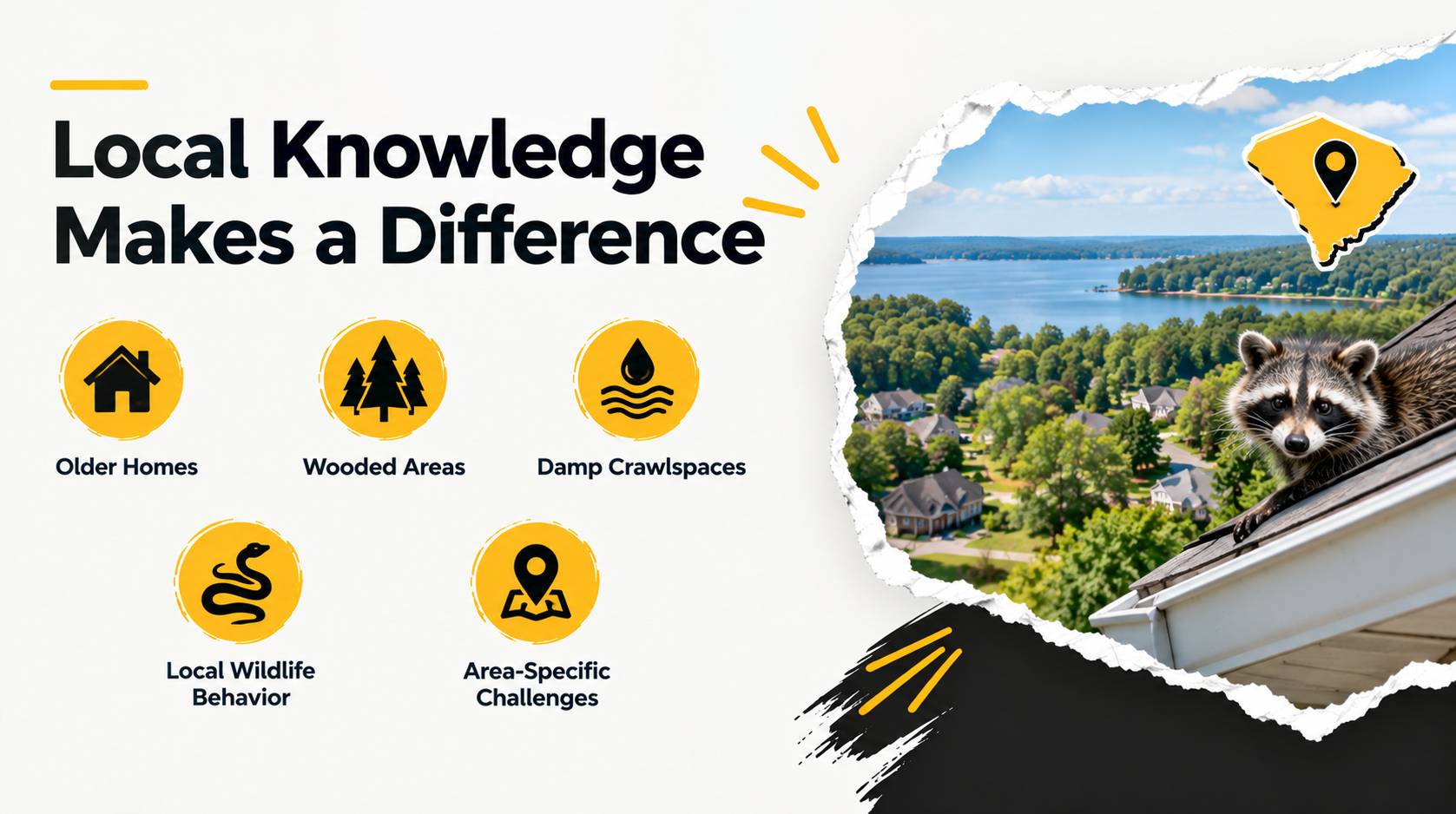
Wildlife behavior and home construction both vary by region. In the Midlands, older homes near Lake Murray, newer subdivisions built next to wooded lots, and crawlspaces that stay damp through summer all create different entry points and different animal pressure than you’d see in another state.
Someone who has worked in these neighborhoods for years knows where raccoons tend to pry at roof edges, which soffit styles squirrels favor, and why snakes show up in certain yards after rodents move in. I’ve put some of that into a homeowner’s guide to snake safety in the Columbia area, including which venomous species people actually run into here.
A chain technician can be excellent too, especially one who has been at the same branch a long time. The difference is that with a national brand you can’t always tell in advance who will show up or how familiar they are with your area. With a local company, you can ask about the experience directly before you book.
Cost and pricing differences
People assume local means cheaper and national means expensive, or the reverse. Neither holds up reliably.
Chains often price from standardized packages, which makes quotes predictable but sometimes less tailored. A local company usually prices after inspecting the property. That could be a single squirrel in an attic corner, or a bat colony that needs a full exclusion and sealing plan. A bat removal job is a good example, because the work is mostly about closing every gap so the colony can’t return, and the scope changes a lot from one house to the next.
Whatever you’re quoted, ask what’s included. A low price that covers trapping only, with no sealing, cleanup, or repair, often turns into a second bill later. Compare quotes based on the full scope of work, not the headline number.
When a national company can make sense
There are real reasons to pick a chain. If you manage properties in several states and want one vendor and one invoice, a national provider simplifies that. If you value brand recognition or want a company with formal corporate policies in writing, that’s a fair preference. And in areas where no established local operator exists, a national company may be your best available option.
Questions to ask before you hire anyone
Whether you choose local or national, these questions show you quickly how a company works. If you’d like to see how ours answers them, I’ve laid out our wildlife removal and exclusion services in detail.
- Who will actually come to my property, and can I speak to them before the visit?
- Are you licensed and certified to handle wildlife in South Carolina?
- Do you use humane trapping and removal methods?
- Does the estimate include sealing entry points, cleanup, and repairs, or only removal?
- What does your guarantee cover, and for how long?
- If the animal returns, who do I call and how quickly do you respond?
- Can you show me recent reviews from customers in my area?
Straight answers to these tell you most of what you need to know. Vague answers tell you something as well.
How I handle wildlife calls at Blythewood
When someone calls us, I want them talking to a person who can explain what’s likely going on and when we can be there. Most jobs start with a full inspection to find every entry point, then a humane removal plan, and cleanup or repair where needed. I finish by walking through what I found so you understand it as well as I do
We’re veteran-owned and serve homeowners and businesses across Columbia, Blythewood, Irmo, Chapin, West Columbia, and the Lake Murray side of Lexington.
Whichever company you end up with, ask the hard questions first. It’s your home, and the person you hire should be willing to answer for the work.
If you’d like to talk it through, I’m happy to hear what you’re dealing with.
Blythewood Wildlife Removal
Phone: 1-803-760-9166
Email: [email protected]
Hours: Open 24 hours
Address: 1314 Lincoln St, Columbia, SC 29201
Serving: Columbia, Lexington, Blythewood, Irmo, Chapin, and West Columbia
- The Hidden Entry Points Wildlife Companies Miss: A Home Inspection Checklist for Rooflines, Soffits, and Utility Gaps - October 23, 2026
- Local Wildlife Removal vs. National Chains: How to Choose Faster, More Accountable Service - October 22, 2026
- Signs of a Raccoon in the House and What to Do About It - September 16, 2026